


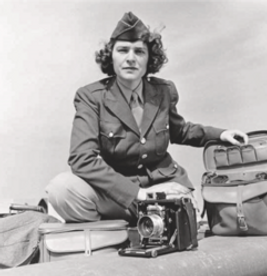
Margaret Bourke-White
1904–1971
The first accredited female war photographer on the front lines — turning conflict into public witness.
Margaret Bourke-White was a pioneering photojournalist who was at the center of the 20th century’s most consequential events - documenting power, conflict, and human survival from inside the environments where they unfolded.
As one of the first photographers for Life magazine, she helped define the modern photo-essay, using images not as illustration but as primary record. Her assignments took her into industrial plants, disaster zones, and war theaters - paces rarely accessible to women journalists at the time.
During World War II, Bourke-White became the first accredited female photographer permitted to work in active combat zones. She flew on bombing missions, traveled with advancing troops, and documented the liberation of Nazi concentration camps.
Her lens also turned toward the United States, where she photographed segregation, labor inequity, and Depression-era poverty. Images such as her documentation of Black flood survivors beneath idealized advertising billboards exposed the stark contradictions between American prosperity narratives and lived reality.
Whether capturing Mahatma Gandhi at his spinning wheel, Soviet industrial expansion, or apartheid-era South Africa, she stood where events were unfolding and recorded what others might never have witnessed firsthand.